
L'startup helpdesk outsourcingconsists of delegating user IT support (levels L1 and L2) to an external technical expert to free founders and developers from daily incidents. As soon as a company reaches the milestone of 15 to 20 employees in 2026, managing access, workstations and breakdowns consumes 15 to 20 hours per week for senior technical profiles. Using an outsourced helpdesk halves the full cost compared to hiring a permanent contract, while guaranteeing a response time of less than 15 minutes and lasting documentation.
The classic trap: why should your CTO and your developers no longer provide L1 support?
In the first months of a startup, versatility is natural. The Chief Technology Officer (CTO) or the first developers configure mailboxes, deploy software and reset passwords. But as the team grows, this informal troubleshooting becomes a major productivity pitfall.
The danger lies in the cost of changing cognitive context. According to the study documented by theLVLUP Agency, the brain requires on average23 minutes and 15 secondsto regain concentration after an interruption. Research also demonstrates a25% increase in error ratewithin ten minutes of an external request.
When a senior developer or CTO is interrupted several times a day for a printer problem, blocked Microsoft 365 access or a faulty VPN, the company directly slows down its software roadmap. L'startup outsourcingcreates an essential protective filter between users and product teams.
Key Takeaways: The Impact of Unstructured Support on Your Engineering
- 23 minutes and 15 seconds: Average time required by the brain to regain maximum concentration after an interruption.
- +25% software errors: Measured increase in code anomalies within ten minutes of impromptu troubleshooting.
- Disproportionate hourly cost: A senior technical profile at €80k/year should not spend 2 hours a day on password resets.
- Protective airlock effect: Dedicated outsourcing absorbs 100% of current requests without ever disturbing the product team.
What are the 4 warning signs that require you to outsource your helpdesk?
The transition to structured support responds to precise operational indicators. As soon as one of the following four signals appears, maintaining artisanal management becomes counterproductive:
More than 10 hours per week absorbed by IT
If your engineers or operations spend two hours a day guiding teams on SaaS tools, their main added value is sacrificed.
The milestone of 15 to 20 employees reached
The analysis ofEverpingconfirms that this level increases requests for onboarding, hardware renewal and identity management.
Onboarding times greater than 48 hours
A recruit who waits several days to get their workstation configured and their access validated on Slack, Teams or Google Workspace experiences an immediate drop in engagement.
Lack of history and documentation
If each breakdown is resolved from memory without a knowledge base, the departure of an employee takes away the company's technical memory.
Comparison of solutions: Permanent recruitment vs classic ESN vs dedicated expert freelancer
To organize its IT support, a department has three models with very different financial and operational logics.
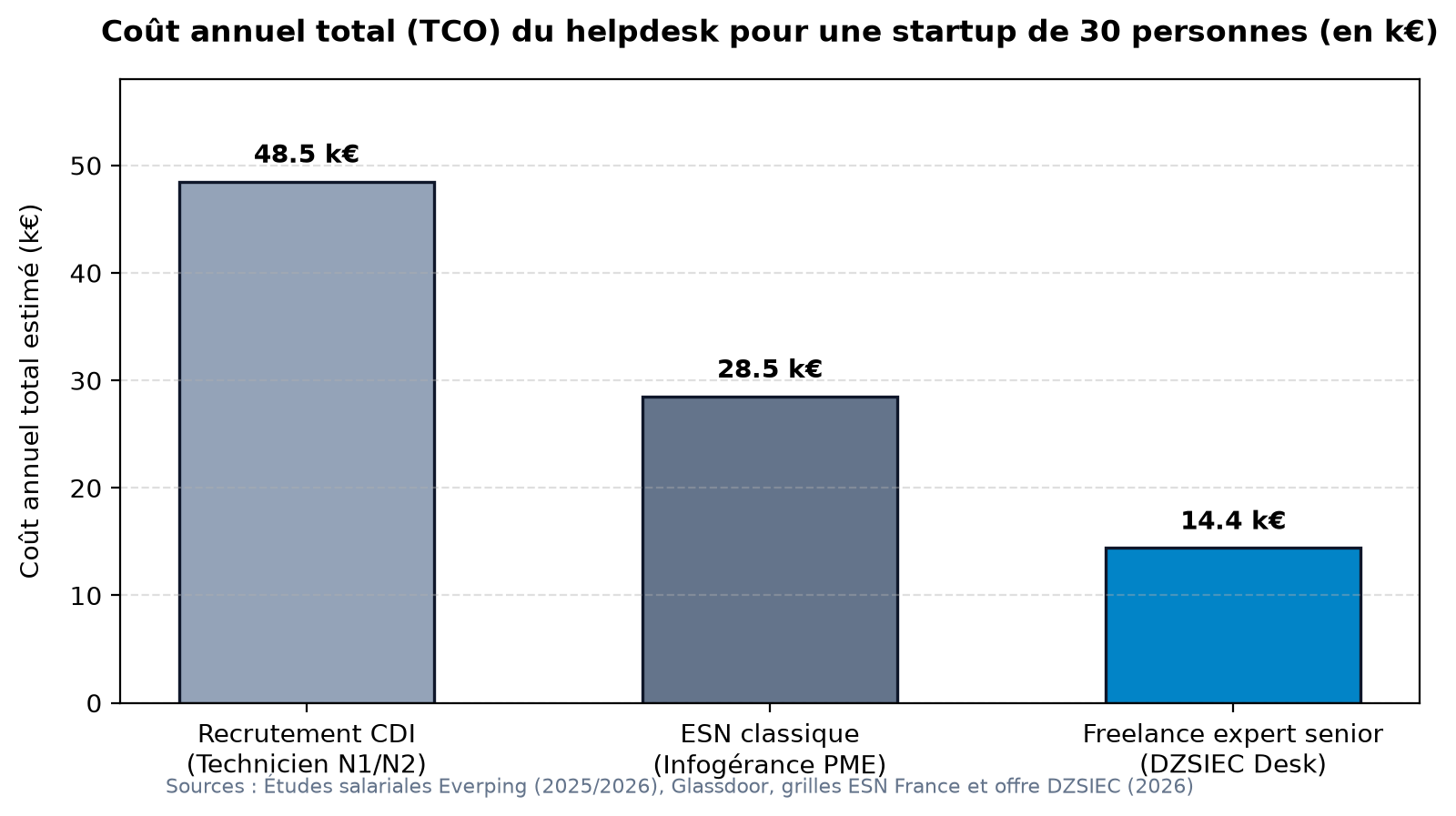
THEpermanent recruitmentof a support technician turns out to be heavy and rigid. According to studies ofCoursera FranceandEverping, the average gross salary of a helpdesk technician in France is €28,800 per year (up to €32,800 in Paris). With employer contributions (~42%), the direct employer cost amounts to €41,000. When including hiring costs and equipment, the total cost of ownership (TCO) exceeds€48,500 per year, for a presence limited to 35 hours and an average turnover of 12 to 18 months.
L'Digital Services Company (ESN)applies a flat rate of €60 to €100 per post per month, or approximately€28,500 annuallyfor 30 positions. This model outsources leave but imposes rigid multi-year commitments and an anonymized call center with high turnover.
Call an expertfreelance IT supportdedicated, as proposedDriss ZUFRI via DZSIEC, combines financial flexibility and operational seniority. For approximately€14,400 per year for 30 positions, the company benefits from a single contact with 15+ years of experience in the field, responsiveness within 15 minutes, bilingual FR/EN support and long-term documentation without binding commitment.
| Evaluation criterion | Permanent recruitment (N1/N2) | Classic ESN | ★ RECOMMENDEDDZSIEC (Senior Freelancer) |
|---|---|---|---|
| Total annual cost (30 positions) | ~48,500 € / year | ~28,500 € / year | ~14,400 € / year (without charges) |
| Operational time | 2 to 3 months (recruitment) | 2 to 4 weeks | 24 to 48 hours |
| Contractual commitment | Rigid contract (CDI) | Commitment 12 to 36 months | Without binding commitment |
| Seniority of the technician | Junior profile (0-2 years) | Multiple operators (turnover) | Senior expert (15+ years in the field) |
| Relational & Languages | Variable | Standardized platform | Human listening, bilingual FR/EN |
| Sustainability of knowledge | Isolated memory | Closed ESN procedures | Documentation on your tools |
How to successfully onboard and outsource your helpdesk without friction?
Entrusting your support to a service provider requires a methodical approach. To successfully integrate aoutsourced SME helpdesk, four proven steps should be followed:
Step 1: The express audit and mapping of the fleet
Review of equipment (Mac and PC), SaaS subscriptions and Microsoft 365 or Google Workspace access to correct immediate flaws (absence of MFA, residual accounts of former employees).
Step 2: Framing access, security and SLAs
Connection to communication channels (Slack, Teams, Crisp or Zendesk) according to the principle of least privilege, signing of a confidentiality agreement (NDA) and commitment to strict SLAs (< 15 min for emergencies).
Step 3: Active daily L1/N2 support
Personalized support for outages, rights resets and MDM deployments (Intune, Jamf) with diplomacy, pedagogy and bilingual French/English responsiveness.
Step 4: Continuous optimization and lasting documentation
Systematic formalization of each resolution using a standardized procedure in Notion or Confluence, and monthly reviews to reduce technical debt and automate recurring requests.
3 Common Mistakes to Avoid When Outsourcing Support
To ensure the success of the operation, founders and operations directors must avoid three common pitfalls:
Mistake #1: Delegating without security oversight or compliance
Transmitting administrator rights without agreement or traceability exposes the structure to cyber risks. European obligations (GDPR, NIS2, DORA) require strict governance and the use of corporate password managers.
Mistake #2: Choosing a low-cost ESN with high turnover
An abnormally low price often hides saturated and outsourced teams. Employees, frustrated by deadlines, end up calling on the CTO again, ruining any time savings and degrading team morale.
Mistake No. 3: Neglecting documentary capitalization
If the service provider keeps its procedures in its own closed system, the startup becomes captive. Technical guides and onboarding checklists must remain in the company's own document space (Notion, Confluence).
Frequently asked questions about helpdesk outsourcing
Conclusion: Unleash your growth with tailor-made IT support
Outsourcing your startup's helpdesk represents a strategic choice for operational efficiency. Every hour saved by your developers and founders is reinvested in improving your product and acquiring new customers.
With 15 years of field experience with fast-growing structures,Driss ZUFRIoffered viaDZSIECpragmatic, calm and deeply human support. With bilingual French/English support, responsiveness within 15 minutes and controlled management of your hybrid assets and Microsoft 365 tenants, you have high-level IT expertise without contractual rigidity.